How Payment Processors Classify Your Business Vertical (and Why It Matters)
Payment processors assign a four-digit MCC code to every merchant that determines your interchange rate, whether you can get approved, and how much risk scrutiny your account receives.
When a business applies for a merchant account or signs up with a payment processor, one of the first things that happens is classification.
The processor assigns a four-digit Merchant Category Code (MCC) to the business, and that code determines almost everything that follows: the interchange rate applied to every transaction, whether specific processors will accept the business at all, the level of compliance scrutiny from the card networks, and the reserve requirements the processor will impose.
Most business owners never see their MCC and don't know what it is. That's a problem, because an incorrect classification can cost real money, and a classification in the wrong risk tier can result in the processor closing an account entirely.
What a Merchant Category Code Is
MCCs are four-digit codes defined by ISO 18245, adopted by Visa and Mastercard as the standard way to classify merchant business type. The ISO standard was introduced in 1987. There are approximately 600 MCC codes in active use.
Each one corresponds to a specific type of business. Stripe's MCC reference guide (stripe.com/guides/merchant-category-codes) is one of the more readable public databases of active codes.
How MCCs are assigned: the acquirer or payment processor assigns the MCC at the point of underwriting. For direct merchant accounts, the underwriter reviews the application, understands the business model, and assigns the appropriate code.
For payment aggregators like Stripe, Square, or PayPal, MCC assignment happens through automated systems based on the business description provided during sign-up.
Businesses do not choose their own MCC. If you describe your business as software-as-a-service, you may be classified under 7372 (Computer Programming, Data Processing).
If you describe it as an online game, you may be classified under 5816. The difference between those two codes is significant in terms of risk classification and processing fees.
Standard MCCs vs High-Risk MCCs
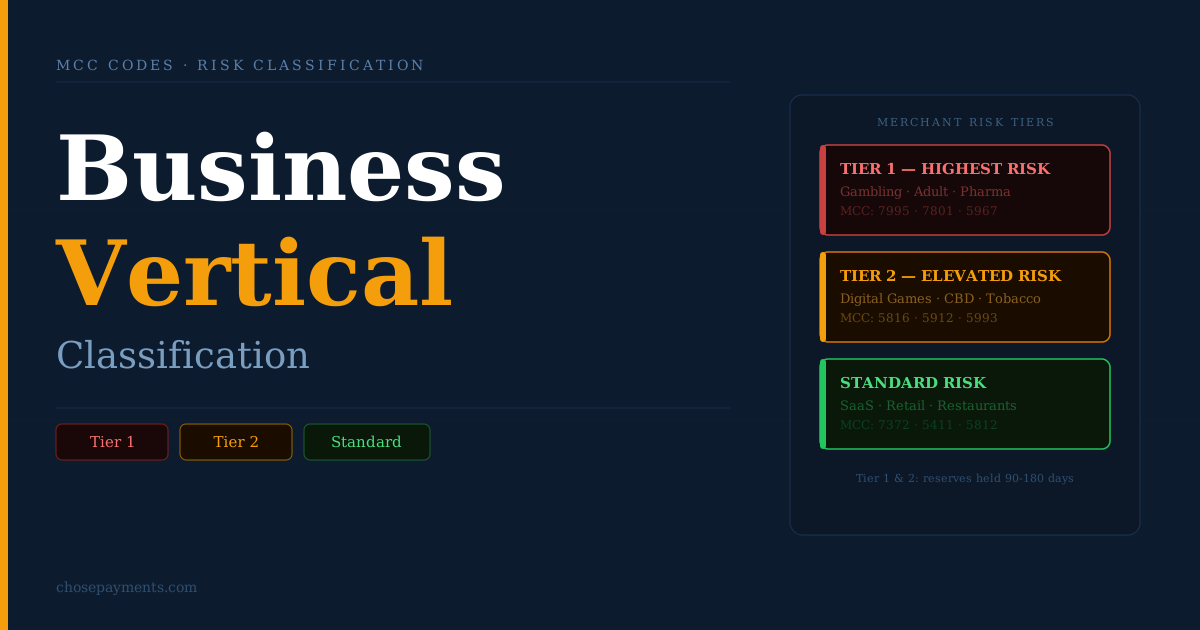
Standard MCCs cover the majority of retail, service, restaurant, hotel, and business-to-business categories. These carry normal interchange rates and receive no additional compliance scrutiny. Examples: 5411 (Grocery stores), 5812 (Restaurants), 7372 (Computer Programming), 4900 (Utilities).
High-risk MCCs are codes that card networks have designated as carrying elevated fraud, chargeback, or regulatory risk.
Merchants in these categories face higher interchange rates on some card types, additional compliance requirements under network programs, refusal from many mainstream processors, and mandatory reserve requirements from acquirers willing to underwrite them.
Specific high-risk MCCs and their risk tier classifications:
- 5816 - Games of skill (card-not-present) - Tier 2 - Elevated chargebacks, regulatory
- 5967 - Direct marketing / adult content - Tier 1 (highest) - Fraud, regulatory, reputational
- 7801 - Government-licensed online casinos (US only) - Tier 1 - Regulatory, gambling laws
- 7995 - Betting, lottery, casino gaming chips, race track wagers - Tier 1 - Regulatory, gambling laws
- 5912 - Drug stores and pharmacies (used for CBD/supplements) - Elevated - Regulatory
- 5993 - Cigar stores and stands (tobacco/vaping) - Elevated - Age verification, regulatory
- 7994 - Video game arcades (used for some gaming platforms) - Elevated - Chargeback patterns
- 5999 - Miscellaneous and specialty retail - Processor-defined - Catch-all
- 6211 - Security brokers and dealers - Elevated - Regulatory, financial services
Tier 1 under Visa's Integrity Risk Program (VIRP) represents the highest compliance obligation. Acquirers accepting Tier 1 merchants must conduct enhanced due diligence, submit merchant information to Visa for registration, and maintain ongoing monitoring reports. This is why most mainstream processors refuse Tier 1 verticals entirely.
What Visa's VIRP and Mastercard's High-Risk Programs Mean for Merchants
Visa Integrity Risk Program (VIRP) - visa.com merchant standards manual: Since May 2023, Visa requires acquirers to register merchants operating in specific high-risk categories with Visa directly. Unregistered high-risk merchants are a compliance liability for the acquirer.
If discovered, the acquirer faces fines. The result is that acquirers either refuse high-risk merchants or apply rigorous due diligence processes.
Mastercard High-Risk Merchant Registration: Mastercard maintains a similar registration framework. Merchants in gambling, adult content, and certain pharmaceutical categories must be registered with Mastercard through their acquirer.
Practical effect: any business in a Tier 1 or VIRP-registered category applying to Stripe, Square, or PayPal will typically be declined at sign-up, or accepted initially and then terminated when automated systems flag the MCC or transaction patterns.
How Business Vertical Classification Affects Your Costs
Interchange rates: MCCs directly influence interchange rates because Visa and Mastercard set different rates for different merchant types. A standard grocery store on a Visa credit card pays interchange of around 1.22% + 5¢. A business in a high-risk MCC may pay elevated rates and be ineligible for preferred interchange programs.
Processing fees: High-risk processors charge significantly more than standard-rate processors. A standard ecommerce merchant might pay 2.9% + 30¢ on Stripe. A comparable business in a high-risk vertical with a specialist acquirer might pay 3.5-5% plus various per-transaction fees.
Reserve requirements: High-risk merchant accounts routinely include rolling reserves of 5-10% of monthly volume, held for 90-180 days. An upfront reserve of 1-3 months' estimated processing volume is also common for new high-risk accounts. On $100,000/month in processing, a 10% rolling 180-day reserve means $60,000 in held funds at steady state.
How to Find Your MCC
For businesses on Stripe: MCCs are available in the Stripe Dashboard under Business settings. Stripe allows merchants to request a review of their assigned MCC if they believe it is incorrect.
For businesses on Square: MCCs are not displayed directly in the dashboard but Square's support team can provide the assigned code on request.
For businesses with a traditional acquiring bank: the MCC appears on merchant account statements and in the merchant agreement paperwork.
What to Do If Your MCC Is Wrong
Common errors include: a SaaS company classified as a direct marketing company (5967) instead of software (7372), placing them in a Tier 1 risk category; a fitness coaching business classified as a gym (7941) instead of professional services, affecting interchange rates.
If the assigned MCC is incorrect: contact the payment processor or acquirer's underwriting or risk team directly; provide documentation of the actual business model (website, product descriptions, sample invoices); request formal reclassification; on aggregator platforms, expect 5-20 business days and direct communication with a risk analyst.
If the MCC is correct and it places the business in a high-risk category, the solution is not to dispute the classification but to find a processor set up to handle that specific vertical.
The Relationship Between MCCs, Business Verticals, and Processor Selection
The most common mistake businesses in elevated-risk verticals make is choosing a processor based on price and simplicity, ignoring whether that processor's underwriting model can actually sustain their business category.
Stripe is cheap and fast to set up. It is not set up to underwrite nutraceutical subscription businesses, online gambling adjacent platforms, or adult content. A business in those categories will be terminated, and the process of getting funds released can take 90-180 days.
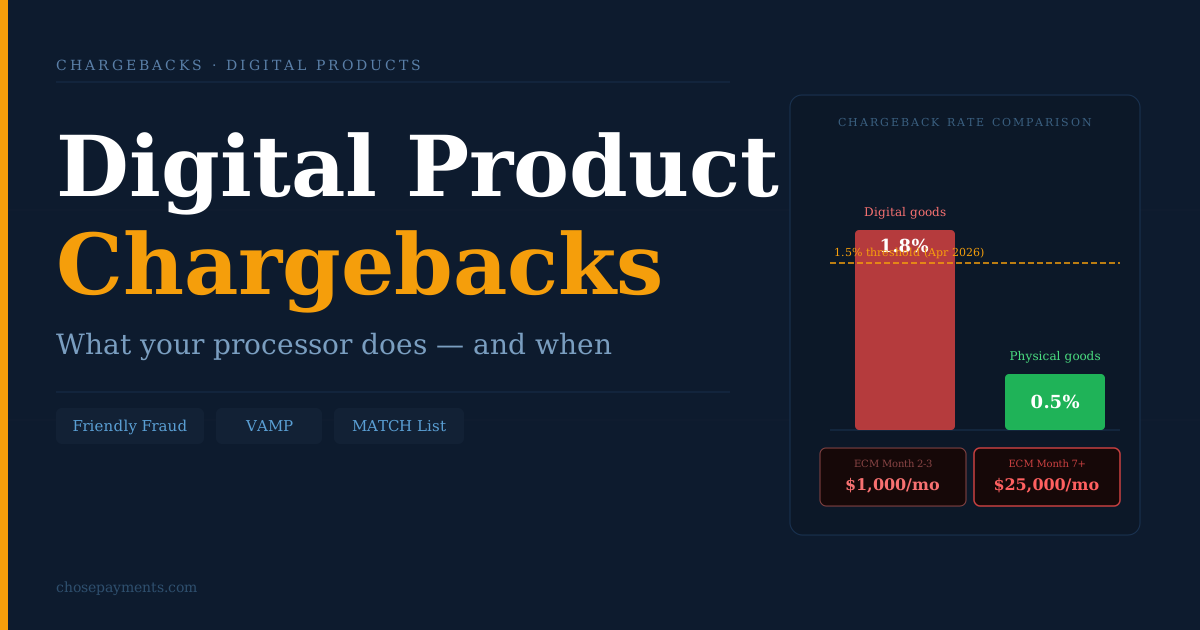
If your business is in the digital goods space, also read about digital product chargeback rates and what processors do about them (link to /digital-product-chargebacks-refunds-payment-processor) - chargeback history is a second underwriting variable on top of the MCC.
Frequently Asked Questions
Common questions about how payment processors classify business verticals and MCC codes.
What is a merchant category code (MCC)?
An MCC is a four-digit number defined by ISO 18245 that classifies the type of goods or services a business provides. Visa and Mastercard use MCCs to determine interchange rates, apply risk classification, and enforce compliance requirements. The code is assigned by the acquirer or payment processor during merchant account setup - not chosen by the merchant. There are approximately 600 MCC codes in active use.
Can I choose my own MCC?
No. MCCs are assigned by the acquiring bank or payment processor based on the business type described during onboarding. Merchants can request a review if they believe the assigned code is incorrect, but the processor makes the final determination. Deliberately misrepresenting a business to obtain a more favourable MCC violates card network rules and can result in account termination and MATCH listing.
What makes a business vertical "high risk" for payment processing?
High-risk classification stems from one or more of: elevated industry-wide chargeback rates, regulatory complexity (gambling laws, pharmaceutical regulations, age verification requirements), reputational risk to the card network, high fraud rates, or negative option billing models that generate disputes. The designation reflects the industry pattern, not the individual business's conduct - a cleanly run CBD business is still classified as high risk because the broader category carries elevated risk patterns.
Will Stripe or PayPal process payments for a high-risk MCC?
Stripe and PayPal both maintain prohibited business lists that exclude specific high-risk categories including adult content, certain firearms products, some pharmaceutical and supplement verticals, and online gambling. Businesses in prohibited categories are declined at sign-up or terminated after onboarding once automated monitoring identifies the mismatch. If your MCC is in a high-risk tier, you need a specialist acquirer, not an aggregator.
How does an MCC affect my interchange rate?
Visa and Mastercard publish interchange rates that vary by MCC, card type, and transaction method. Some MCCs qualify for preferred interchange categories (utilities and fuel have lower rates), while others face above-standard rates. On a flat-rate plan like Stripe's 2.9% + 30¢, the MCC doesn't change what you pay. On interchange-plus pricing, your MCC directly affects every transaction, and high-risk MCCs may be ineligible for preferred interchange programmes entirely.
What is the difference between an MCC and an SIC code?
SIC (Standard Industrial Classification) codes are a US government classification system used for regulatory and statistical purposes, maintained by the SEC and IRS. MCCs are a payment industry classification used by card networks. They are not the same system and do not map directly to each other. A business may have one SIC code for tax filing and a different MCC for payment processing. The MCC is what matters for card acceptance and interchange rates.
What is Visa's VIRP and does it affect my business?
Visa's Integrity Risk Program (VIRP) replaced the Global Brand Protection Program in May 2023. It requires acquirers to register merchants in specific high-risk categories directly with Visa and maintain ongoing compliance monitoring. Businesses in VIRP-registered categories, primarily gambling, adult content, and certain pharmaceutical MCCs - need a Visa-approved acquirer set up to handle VIRP compliance. Most mainstream processors cannot accommodate this, which is why they refuse these merchants outright.
Can my MCC change after I open a merchant account?
Yes, and it can happen in either direction. If a processor's risk team determines the assigned code doesn't match your actual business model, they can reclassify you - which may increase your risk tier, change your interchange rates, and trigger reserve requirements. This often happens when a business expands into new product categories or when transaction patterns are inconsistent with the assigned MCC. Periodic review of your MCC after material business changes is good practice.