Merchant Acquirer vs Payment Processor: What's the Difference?
A merchant acquirer holds your merchant account and takes the financial risk. A payment processor routes the transaction. Here is exactly how they differ, and why it matters when your account gets frozen.

When a customer taps their card at a terminal or clicks Pay on a checkout page, the transaction touches two types of institution before money reaches the merchant's bank account: a payment processor and a merchant acquirer.
Most businesses use them interchangeably. The terms refer to different functions, and the distinction matters the moment a dispute is raised, an account is frozen, or a business applies for merchant services in a higher-risk category.
This is a practical breakdown of what each does, who the major players are, how they interact in a live transaction, and what it means to have one entity performing both roles.
What a Merchant Acquirer Does
A merchant acquirer - also called an acquiring bank - is a licensed financial institution that holds a merchant account on behalf of a business. The merchant account is the holding vehicle through which card payments flow before settlement into the business's operating bank account.
Underwriting: Before a business can accept cards, the acquirer underwrites the merchant account - assessing the business model, chargeback risk, financial stability, and compliance with card network rules. A business applying for a merchant account is asking an acquirer to extend credit risk on their behalf. When a chargeback happens, the acquirer funds the customer's bank before recouping from the merchant. The acquirer carries that risk.
Settlement: After a transaction is authorized and batched, the acquirer receives net funds from the card network (the transaction amount minus interchange - the fee paid to the issuing bank) and deposits those funds, less their own margin, into the merchant's bank account. Settlement timelines are typically one to two business days for established merchants.
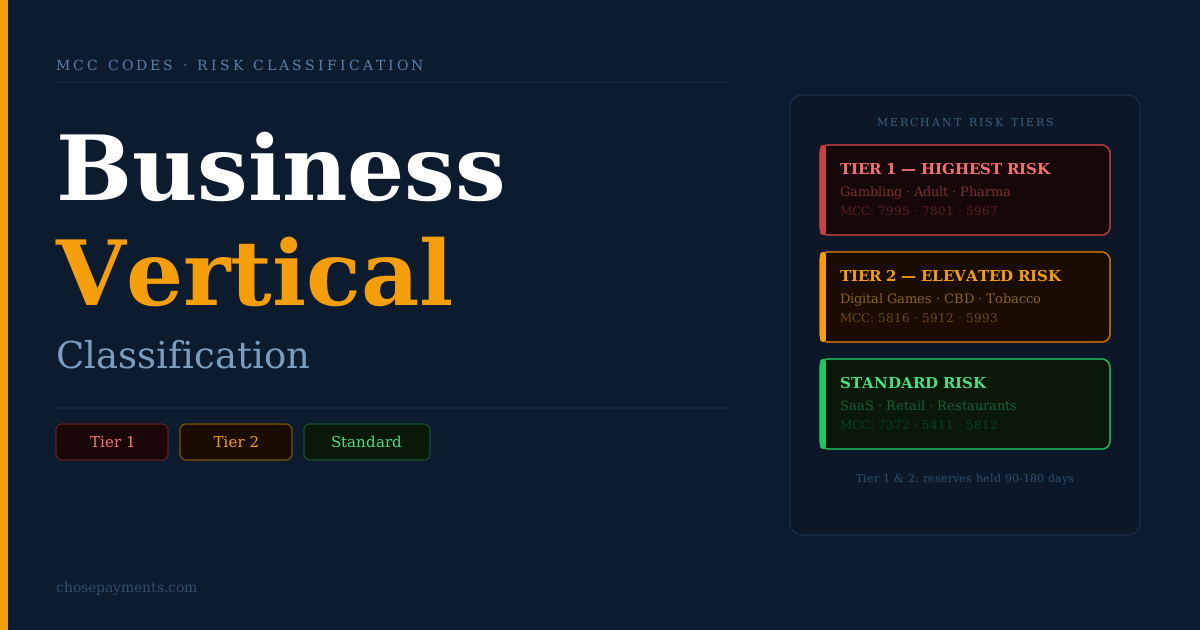
Reserve management: For businesses with elevated chargeback risk, the acquirer holds a reserve - a percentage of each transaction held back to cover potential dispute liability. Rolling reserves (typically 5-10% held for 90-180 days) and upfront reserves (a lump-sum deposit before processing begins) are both mechanisms acquirers use to protect their exposure.
Chargeback management: When a customer disputes a transaction with their bank, the chargeback flows from the issuing bank through the card network to the acquirer, who debits the merchant account and initiates the dispute process.
Top US merchant acquirers by processing volume (2026 TSG Directory-tsgpayments.com/global-payments-tops-tsgs-2026-directory-rankings ):
- Global Payments (inc. Worldpay): $2.8 trillion
- JPMorgan Chase: $2.5 trillion
- Fiserv: $2.2 trillion
- Stripe: $902.5 billion
- Wells Fargo: $675 billion
- PayPal: $585 billion
- Elavon (US Bank): $442 billion
- Bank of America: $428.7 billion
- Adyen: $316 billion
- Block (Square): $200.2 billion
Global Payments moved to the top position in 2026 following the completion of its Worldpay acquisition from FIS in January 2026. The combined entity now processes over 20% of all US payments volume.
What a Payment Processor Does
A payment processor is the technology layer that moves transaction data between the merchant, the card network (Visa or Mastercard), and the issuing bank.
The processor formats transaction messages in the ISO 8583 messaging standard, routes authorisation requests, and returns the approval or decline response in near real-time.
Authorisation routing: When a card is presented, the processor captures the card data, formats it into a network message, and sends it through the acquirer's network connection to Visa or Mastercard, who route it to the issuing bank for approval.
Security and fraud tooling: Processors handle PCI DSS compliance at the point of data capture, 3D Secure (3DS2) implementation for card-not-present transactions (stripe.com/resources/more/3d-secure-authentication), and real-time fraud scoring. Stripe's Radar and Adyen's RevenueAccelerate are both processor-layer fraud tools.
Gateway functionality: For ecommerce, the processor operates the payment gateway - the secure API or hosted payment page through which card data is submitted and tokenised. Tokenisation replaces the raw card number with a non-sensitive reference token, eliminating PCI scope on the merchant's servers.
Reporting and data: Transaction data, declined reason codes, refund management, reconciliation files, and API-based reporting are all processor-layer functions.
How They Work Together in a Transaction
A card-not-present payment moves through this chain in under two seconds:
- Customer enters card details on the merchant's checkout page
- The payment gateway (processor) tokenises the card data and sends an authorisation request
- The processor routes the request through the acquirer's network connection to Visa or Mastercard
- Visa/Mastercard routes to the customer's issuing bank
- The issuing bank approves or declines, checking available credit and fraud signals
- The response travels back: issuer to network to acquirer to processor to merchant
- The merchant receives an authorised or declined status within 1-2 seconds
- At batch settlement (typically end of day), the processor submits all authorised transactions
- Visa/Mastercard nets interchange and settles to the acquirer
- The acquirer deducts its margin and fees and deposits the remainder to the merchant's bank account, typically T+1 or T+2
The processor handles steps 1-6. The acquirer handles steps 3, 7, 9, and 10. Both are present in every transaction.
When One Company Does Both
The major payment aggregators - Stripe, Square, and PayPal - operate as both processor and acquirer. Merchants on these platforms do not have individual merchant accounts. Instead, all merchants share a single master merchant account held by the aggregator.
Speed of setup: A business can start accepting payments on Stripe within minutes. There is no underwriting process for individual merchants, no application, no manual review.
Account stability trade-offs: Because merchants share a master account, Stripe, Square, and PayPal apply automated risk monitoring that can result in account holds, fund freezes, or terminations without the advance notice that a traditional acquiring bank would typically give.
A business generating elevated dispute rates can find their account suspended and funds held, sometimes for 90-180 days, with limited recourse.
Pricing: Aggregators price with a flat rate (Stripe's standard US rate: 2.9% + 30¢ per card transaction). Traditional acquirers price on an interchange-plus basis - you pay the network's actual interchange rate plus a small acquirer margin.
For high-volume businesses, interchange-plus pricing is typically cheaper. A $1M/month business paying interchange-plus at IC + 0.15% pays considerably less than the same business on Stripe's flat rate.
The Practical Difference for Merchants
Low-risk, low-volume business: The acquirer/processor split is invisible. Stripe, Square, or PayPal handles both roles. Setup is fast and pricing is simple.
High-volume business: Interchange-plus pricing from a direct acquirer is materially cheaper than aggregator flat rates once monthly volume exceeds roughly $50,000-$75,000.
A direct acquiring relationship also provides more stability - a dedicated account manager, a formal underwriting process, and clearer contractual protections if a dispute arises.
Higher-risk business: Aggregators apply risk models that treat entire verticals as elevated-risk regardless of individual merchant history. A subscription software company with a legitimate SaaS product has been terminated by Stripe or PayPal because their MCC or transaction pattern matched a risk profile.
A direct acquirer that specialises in high-risk merchant accounts underwrites the individual business, understands the vertical, and provides a contractual relationship with defined dispute and termination processes.
The acquirer is ultimately the counterparty that determines whether your business can take card payments. Picking the right one - matched to your volume, vertical, and risk profile - is a more consequential decision than picking a payment gateway.
See how payment processors classify your business vertical before you apply: Risk analysis
Frequently Asked Questions
Common questions about merchant acquirers and payment processors.
What is the difference between a merchant acquirer and a payment processor?
A merchant acquirer is the financial institution that holds your merchant account, underwrites your business for card acceptance, and settles funds into your bank. A payment processor is the technology layer that routes transaction data between the merchant, the card networks (Visa, Mastercard), and the issuing bank. The acquirer takes the financial risk; the processor handles the data routing. Both are present in every card transaction.
Is Stripe a payment processor or a merchant acquirer?
Stripe operates as both. It is a payment aggregator that functions as a processor and an acquirer simultaneously, holding a master merchant account under which all Stripe merchants are sub-merchants. This is why merchants can go live in minutes without a formal underwriting application. The trade-off is that automated risk monitoring can result in account holds or terminations with limited advance notice. As of 2026, Stripe ranks fourth in US processing volume at approximately $902 billion annually.
Why would my funds be held by an acquirer?
Acquirers hold funds for three main reasons: elevated chargeback ratios, suspicious transaction patterns (volume spikes or unusual geographies), or business model risk identified at onboarding or through ongoing monitoring. Holds typically range from 5–10% of monthly processing volume and last 90–180 days. With aggregators like Stripe and PayPal, holds can be triggered more abruptly and with less documented reasoning than with a traditional acquiring bank.
What is an acquiring bank?
An acquiring bank is the same as a merchant acquirer — a financial institution licensed by Visa and Mastercard to issue merchant accounts and settle card transactions on behalf of businesses. Examples include JPMorgan Chase, Bank of America, Fiserv, Global Payments, and Adyen. The term "acquiring" refers to the fact that the bank acquires (receives) the transaction funds from the card network on the merchant's behalf before passing them on.
What is interchange and who keeps it?
Interchange is the fee paid by the acquirer to the card issuer on every transaction, set by Visa and Mastercard. For a typical US credit card transaction, interchange is around 1.5–2.5% of the transaction amount. The acquirer does not keep interchange — it passes it to the card network, which passes it to the issuing bank. The acquirer keeps a smaller margin on top, typically 0.1–0.3% for direct merchants.
Can I use a different payment processor with the same acquirer?
Yes. In a traditional acquiring setup, the acquirer and processor are sometimes separate companies. A merchant can switch gateway or processor without changing their acquiring relationship if the new processor is compatible with the same acquirer. This is common in enterprise setups. Aggregators like Stripe bundle both into one contract, so switching means changing both simultaneously.
What happens when I exceed card network chargeback thresholds?
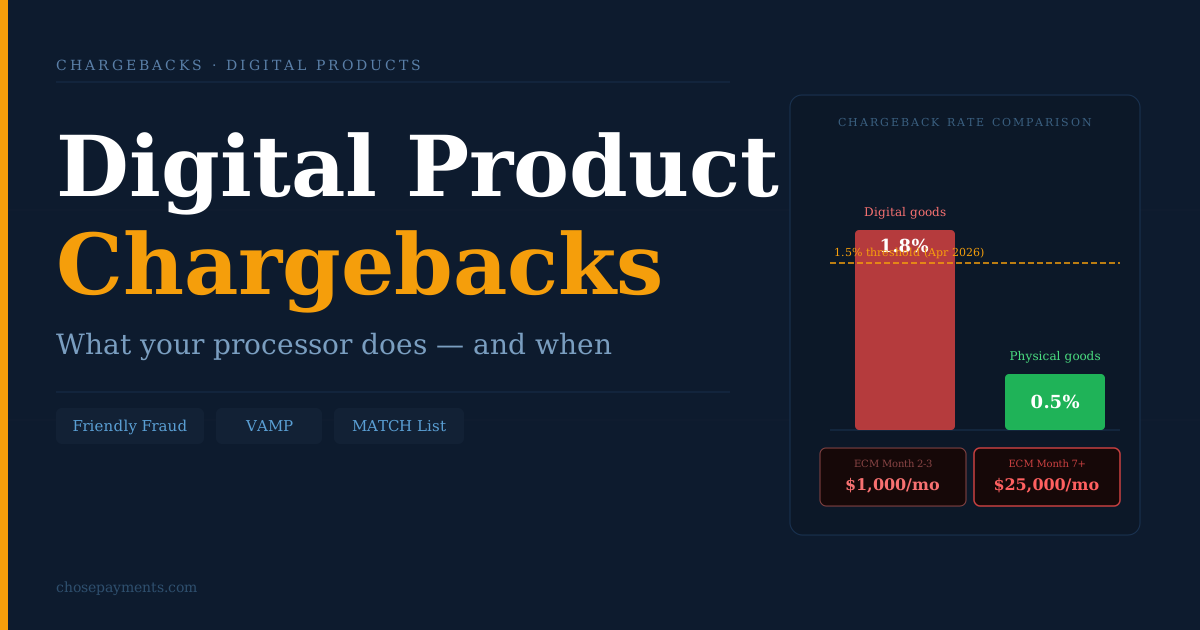
Card networks monitor chargeback ratios through programs like Visa's VAMP and Mastercard's Excessive Chargeback Program (ECP). Mastercard's ECM threshold is 100+ chargebacks per month and a ratio exceeding 1.5%. Visa's excessive threshold dropped to 1.5% in April 2026, with fines of $8 per dispute. Fines are assessed against the acquirer and passed to the merchant. Sustained high chargeback ratios can result in MATCH listing, making it very difficult to open a new merchant account.
Is interchange-plus pricing always cheaper than flat-rate pricing?
At higher volumes, yes. Interchange-plus means you pay the actual interchange rate plus a fixed acquirer margin. Since debit cards carry lower interchange than premium credit cards, interchange-plus passes those savings to the merchant. Stripe's flat rate of 2.9% + 30¢ blends all card types into one rate, meaning merchants with a high proportion of debit transactions subsidise those paying with premium rewards cards. The crossover point is typically around $50,000–$75,000 in monthly card processing volume.